
The cleaners were still hosing the north arcade when I got to the square at ten past seven, and the only other people out were two groundskeepers and a man selling bread from a cart. By nine the tour groups arrive; by eleven the heat arrives. Everything worth seeing in Isfahan happens in the gap between those two arrivals.
The square at seven in the morning
Naqsh-e Jahan is big enough that you cannot photograph it whole from any one corner, which is the first thing the plans never tell you. The bazaar arcade on the north side opens before the stalls do, and walking it in that hour gives you the geometry of the place: brick vaults, a long ribbon of shade, and the smell of bread from a cart parked by the entrance.
I asked the man how early he came and he said he had been there since five, because the bazaar workers are his whole trade. That is the useful version of a city square, not the one in the brochure. Arrive before the first coach parks on the west side and you get the same monument with nobody in it.
A mosque with no minarets
Sheikh Lotfollah sits on the east side of the square, and the first surprise is what is missing: no minarets, no courtyard of the usual size, just a low entrance that opens onto a dome. Construction started in 1609 and took seventeen years, and the tilework on the inside shifts colour by the hour, from cream in the morning to a dusty rose around four in the afternoon.
The standing theory is that it served the court rather than the public, which is a polite way of saying nobody has settled the argument. What you can settle is the timing. Stand under the dome at opening and the light comes through the east windows; come back at four and the same tiles read as a completely different colour scheme.
The Friday Mosque, ten minutes north of the square, is the quiet counterweight. It went up in 1088 on a site that had been a Zoroastrian fire temple, which is why the plan never quite matches the decoration: brick vaults from one century, a carved mihrab from another, cloisters hidden behind the arcades. Nothing about it is photogenic in the way the square is photogenic, and after two hours of tiles that is exactly the point.
The hall with the ceiling of vases
Ali Qapu faces the square from the west, and the terrace is the reason to climb it. From up there you look straight across to the mosque entrance, which is exactly the view the court wanted when polo matches and firework displays were being staged below. The acoustic room on the sixth floor is the part I still think about: niches cut into the plaster in the shape of vases and instruments, and a voice in the corner carries to every other corner without ever getting loud.
The palace was partly pulled down in the Qajar period, so half the climb is ruin and half is decoration. That mixture is the honest version of the building, and it is a better hour than the restored pavilions on the other side of town.
West of the square, Chehel Soutoun is the one building that does the arithmetic openly. The name means forty columns, and there are twenty; the reflecting pool in front supplies the other twenty whenever the water is still. Shah Abbas used it as a reception hall from 1647, and the ceiling is inlaid with mirror work and floral marquetry that rewards a slow look. Go late, when the school groups have gone and the garden is empty enough to hear the fountain.
Lunch on the Armenian side
The cathedral in the Armenian quarter was built between 1606 and 1664, and the interior does the thing I like best in this city: European biblical scenes painted next to Persian floral borders, neither one winning. The quarter itself is quiet, with houses around a small square and a couple of cafes where the lunch runs longer than it should.
I ended up sharing a table with a retired teacher who had taught French for thirty years and wanted to argue about Chardin, the traveller who called this the most welcoming town he had ever seen. He made the point that visitors quote that line and then leave after two days. His version was simpler: three days, or do not pretend you have seen it.
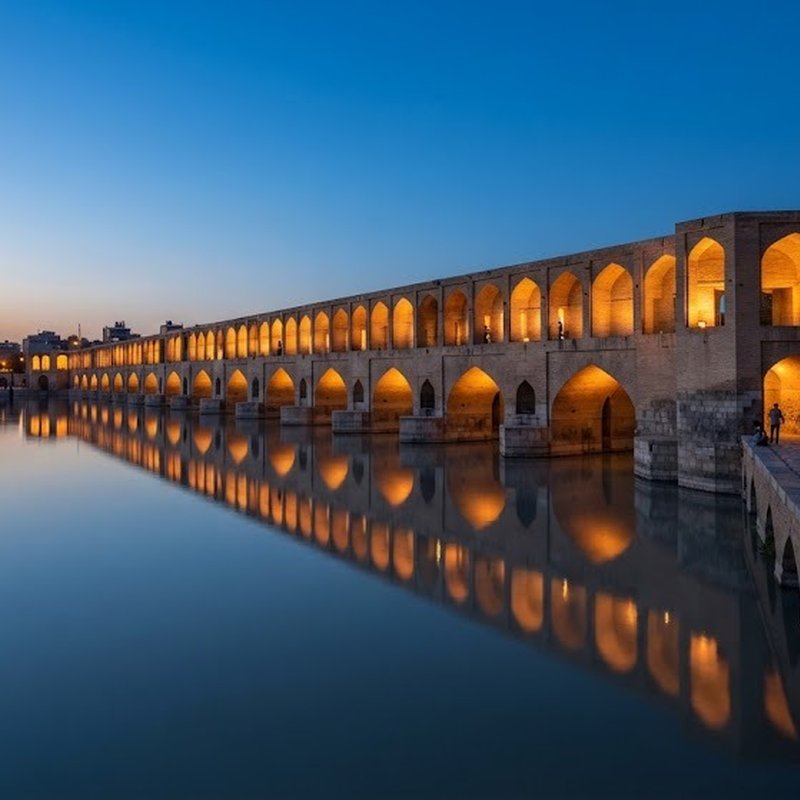
The bridge fills up after ten
Every visitor photograph of the Zayandeh river is taken in daylight, and it is the least interesting version. The thirty-three arch bridge and Khaju both turn into a public living room once the sun goes down: families with thermoses, students on the steps, someone with a kettle and a stack of paper cups.
The oldest crossing here dates back to the Sasanian period, which puts the whole thing in perspective; the river has been the reason for this city since before anybody built a square on it. I sat on the lower steps of Khaju until a street vendor started packing up his cart around midnight, and the lights along the arches were switched off one section at a time.
That is the image I kept: a bridge going dark in pieces, with the sound of the water underneath and somebody still arguing politics on the steps behind me.