
The standard loop out of Tehran - west to the old capitals, south to Fars, then back through the central desert - is the itinerary almost every agency still prints. Read as a list of stops it looks overstuffed; read as three separate trips it makes sense, and that change of reading is what decides whether the fifteenth day exists or not.
Three trips sharing one road book
The first leg is a plateau crossing: Qazvin, Hamedan, Kermanshah. The second is a descent into the sugarcane country around Ahvaz and the Elamite sites on the Iranian side of the Gulf. The third is the Fars and Isfahan block that people actually come for. Each has its own driving rhythm, its own hotel standard and its own best month, and pretending they are one continuous journey is why the route gets a reputation for exhaustion.
Practically, that means booking the loop as three hotel bases rather than one long thread. When somebody asks me whether fifteen days is the right length, my answer depends on whether they are willing to sleep in three towns instead of seven.
The western leg is where the miles buy something
Out of Tehran the road climbs through Qazvin, where the shrine of Shahzadeh Hussain and the Friday Mosque make a decent two-hour stop, and then runs on to Hamedan. Hamedan was the capital of the Medes, and it holds the pieces that explain why: the tomb of Avicenna, who died in 1034, the twelfth century Alavyan tower, and the Ganjnameh inscriptions cut into the rock face by Darius and his son Xerxes.
West again, halfway to Kermanshah, sits Kangavar and a temple to Anahita, patron goddess of the waterworks, dating from around 200 BC. Then Bisotun, where the Achaemenid relief shows Darius facing the nine kings he defeated on his way to the throne. This is the densest stretch of the whole itinerary, and it is the one most often shortened.
Kermanshah closes the leg with Tagh-e Bostan, the Sassanian hunting scenes carved into a rock shelter, including Khosrow II on his horse, and the painted interior of the Tekiyeh Moaven Al Molk. Two full days here is the minimum; one is the usual mistake.
The southwest costs a day and half of it is heat
South from Kermanshah the route runs through Ilam province to Ahvaz, past the broken Sassanian crossing known as Pol-e-Dokhtar, with a diversion to Shushtar where the old channels, dams and water mills are cut into the limestone above the Karun. From Ahvaz the excursion to Chogha Zanbil and Susa is a full day: the ziggurat raised by Untash Gal around 1250 BC, the Elamite necropolis at Haft-Tappeh opened in the 1960s, and Susa itself, one of the oldest continuously occupied places in western Asia, with the Achaemenid palace remains and the tomb associated with the prophet Daniel.
All of it sits in the hottest part of the country, and the difference between April and July is the difference between a usable day and a wasted one. I would only keep this leg between March and early May, or in the last weeks of autumn.
Fars is the part nobody skips
Shiraz gets two days because the city itself justifies them: the Eram garden with its reflecting pool and pavilion, the tombs of Hafez and Saadi, the pink tiled mosque from the nineteenth century, the citadel of Karim Khan in the middle of town, and the Vakil bazaar, which is shut on Fridays and therefore needs planning around. The shrine of Shah-e-Cheragh can only be seen from outside by visitors who are not Muslim, so factor that into the morning rather than discovering it at the gate.
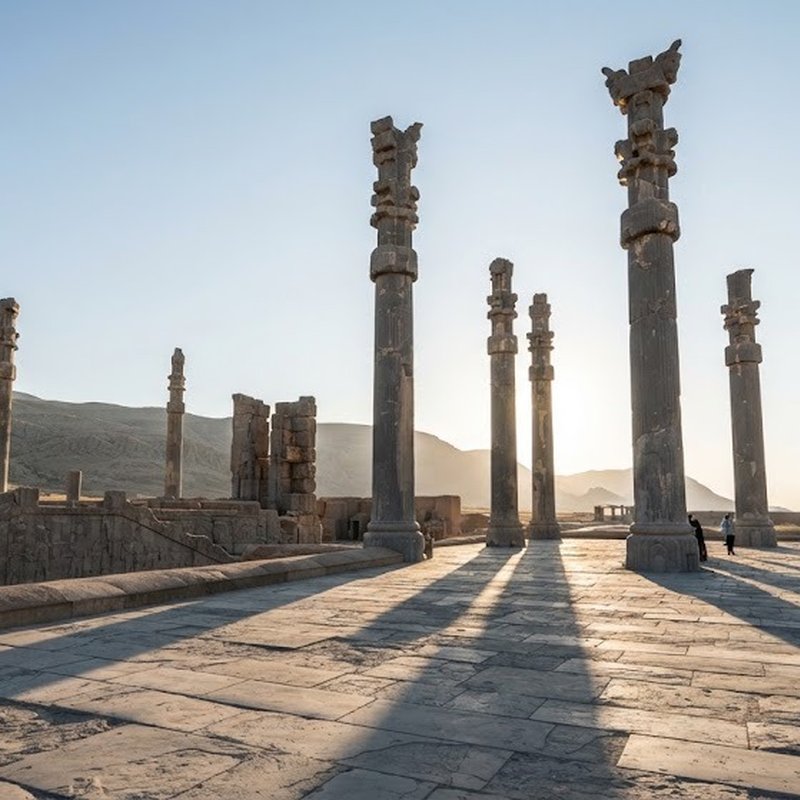
Persepolis lies sixty kilometres out and Naqsh-e Rostam is seven kilometres beyond it, which makes the pair an easy single day: the ceremonial capital where Darius, Xerxes and Artaxerxes received delegations, then the rock cut tombs and the seven Sassanian reliefs opposite them. A second excursion runs northwest to Pasargadae and the plain tomb of Cyrus, with a stop in Abarkuh to look at the cypress that has been growing there for four thousand years.
Yazd is the reward for the desert stretch. The fire temple there keeps a hearth that has not gone out for more than a millennium, the Friday Mosque of 1324 carries the tallest portal and minarets in the country, and the Fahadan quarter of mud brick lanes is best walked before the afternoon heat. Between Yazd and Isfahan the road passes Na'in and a string of caravanserais, which is the part of the route where the map and the history finally agree with each other.
What the driving actually looks like
| Leg | What you gain | Days worth taking |
|---|---|---|
| Tehran to Hamedan | Medes capital, rock inscriptions, tombs | Two |
| Hamedan to Kermanshah | Anahita temple, Bisotun relief, Sassanian carvings | Two |
| Kermanshah to Ahvaz | Bridge ruins, Shushtar waterworks | One and a half |
| Chogha Zanbil and Susa | Ziggurat, Elamite mounds, palace remains | One |
| Shiraz and the tombs | Gardens, poets' tombs, Vakil bazaar | Two |
| Persepolis and Naqsh-e Rostam | Ceremonial capital, royal tombs, reliefs | One |
| Yazd to Isfahan | Fire temple, desert villages, the square | Two |
The table is the argument in one place: seven blocks, and only three of them need a car for more than a morning. Everything else is a stop on a road you were going to drive anyway.
What I would cut first
Start by dropping the Ahvaz block unless the Elamite sites are the specific reason for the trip. That single cut removes two long driving days and the worst heat exposure, and it leaves the itinerary with a clean shape: plateau, Fars, centre. If a fifteenth day is still available, spend it in Isfahan rather than adding another town, because the city rewards a slow morning the way the road blocks never do.
The decision rule I use is simple. Keep every stop that sits within ninety minutes of the line; question anything that costs a full day round trip; and never add a town just to balance the map. When the loop stops feeling like a crossing and starts feeling like a list, the itinerary is already too long.